









Residential Proxy
Avoid getting blocked while scraping and collecting data easily with BestProxy residential proxy.

Proxies for all use cases
We specialize in socks5 residential proxy
Obtain global 200+ country, state, city-level positioning


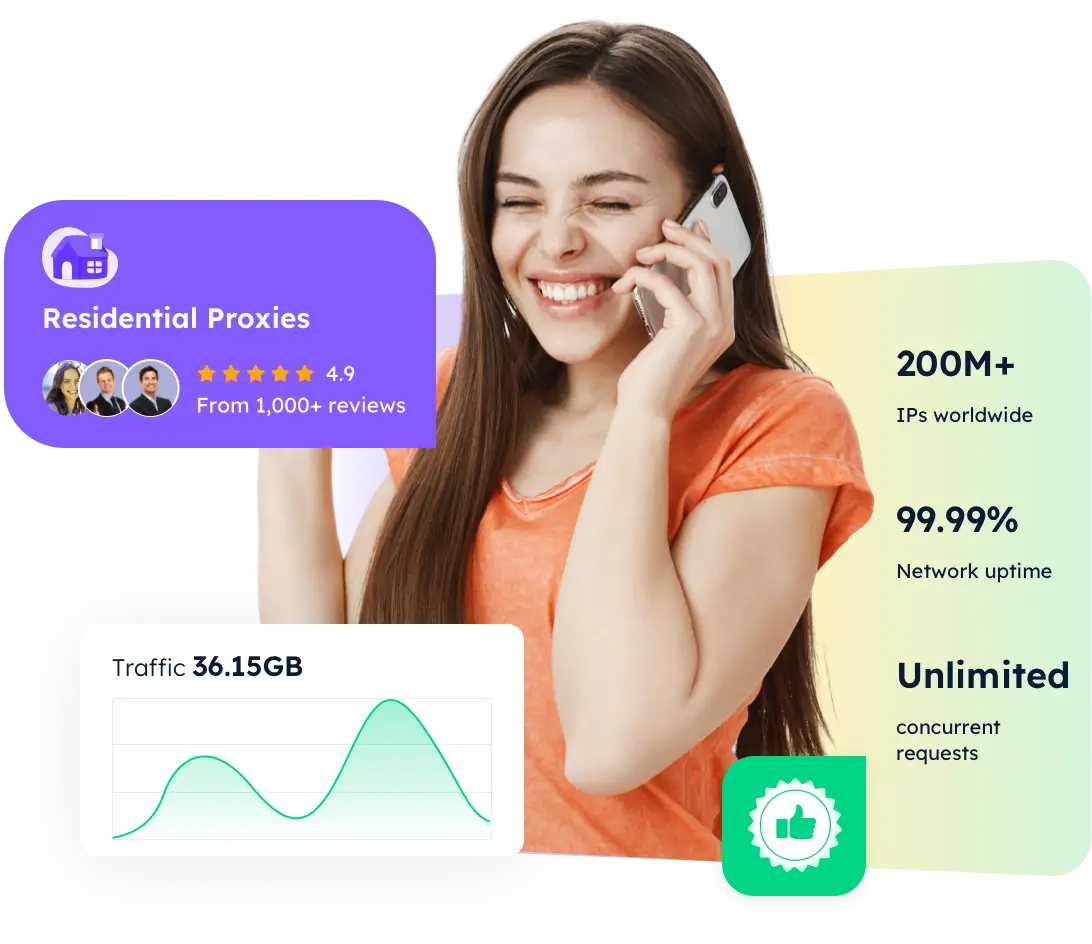
80M+ genuine residential IP addresses for safe and efficient web scraping.
Popular regions: US,GB,CA,IN,BR,MXHTTP/SOCKS5Avg. 99.5% Success RatesSupport API and User&Pass AuthRotate ResidentialCountry and city level positioningDedicated customer service managerIP availability 99.9%Popular regions: US,GB,CA,IN,BR,MXHTTP/SOCKS5Avg. 99.5% Success RatesSupport API and User&Pass AuthRotate ResidentialCountry and city level positioningDedicated customer service managerIP availability 99.9% Most PopularPopular regions: US,GB,CA,IN,BR,MXHTTP/SOCKS5Avg. 99.5% Success RatesSupport API and User&Pass AuthRotate ResidentialCountry and city level positioningDedicated customer service managerIP availability 99.9%Popular regions: US,GB,CA,IN,BR,MXHTTP/SOCKS5Avg. 99.5% Success RatesSupport API and User&Pass AuthRotate ResidentialCountry and city level positioningDedicated customer service managerIP availability 99.9%
Residential proxy IP has high purity and strong confidentiality. Using BestProxy's residential proxy can protect your privacy and security by avoiding websites tracking your real IP address.
 Bundle discounts
Order in bulk to maximize your savings without compromising on performance.
 Dedicated Residential Proxies
No sharing, no splicing - your dedicated proxy is available only for you while you use it.
 Easy self-service dashboard
Get complete control, customize your preferences, and monitor your usage effortlessly.
Our residential proxies work with all popular programming languages, ensuring a smooth connection to other tools that are in your business suite.
Read documentation ixBrowser
 AdsPower
 Playwright
 Puppeeter
 Scrapy
 Selenium
 Incogniton
 Integration
 Ad Verification
Rotating residential proxies are the most effective tool for checking how ads are displayed to different audiences globally.

 Market Research
Get the most accurate data from anywhere in the world without restrictions. Gather valuable market insights crucial for expanding your business.
 Social Media
Manage your social media presence and promote your business without worrying about bans. Easily reach new markets without geographic restrictions.
 E-commerce
Our vast proxy pool can help you monitor each country for competitive insights and intelligence to revolutionize your pricing strategy.
Proxy Knowledge Guide
If you can't find something or need assistance, please contact us at [email protected]


A video downloader API is a service that accepts video or playlist requests and returns processed media files, metadata, or delivery outputs through a structured interface. Instead of building and maintaining your own public media handling workflow, you can send requests and receive predictable results in a format your team can use.
This type of API is useful for teams that work with publicly accessible video or audio content at scale and need a stable way to manage collection, processing, and delivery.
Teams that study public media trends often need repeatable access to video files, audio tracks, subtitles, or metadata. A video downloader API helps standardize that process and makes it easier to move media into analysis pipelines.
If your team prepares training inputs for speech, vision, or multimodal projects, the API can help organize how public media is retrieved and delivered to storage. That reduces manual handling and keeps input formats more consistent.
Some businesses need a dependable workflow for moving public video assets into review, archiving, or internal processing systems. An API-based approach reduces repeated manual work and makes output handling more predictable.
If you are building internal tools, dashboards, or automated workflows, a video downloader API can reduce engineering effort at the infrastructure layer. Your team can spend less time managing delivery logic and more time on business workflows.
A video downloader API turns public media handling into a structured integration workflow. For teams that need scalable, organized, and reliable delivery of public video or audio data, it is often a more maintainable option than relying on ad hoc scripts.
Many teams start with scripts for downloading and organizing public media files, but that approach often becomes harder to manage as volume grows. A video downloader API changes the workflow by moving routine processing and delivery steps behind a structured service layer.
The main difference is not only speed. It is about consistency, operational effort, and how easily the workflow can scale across multiple teams or use cases.
With a self-built workflow, your team must maintain request logic, format handling, storage delivery, and job monitoring on its own. With an API, those steps are standardized through one integration path.
When multiple scripts evolve over time, output formats can become inconsistent. An API makes it easier to keep media files, metadata, and delivery destinations aligned with a single processing rule set.
Teams often need media files to move directly into cloud storage or downstream processing queues. A managed API can simplify how files are transferred and reduce the number of manual handoff steps in the workflow.
If research, product, and data teams all rely on the same public media workflow, a central API is easier to govern than separate script collections owned by different people.
A self-built workflow can work for small experiments, but a video downloader API is usually a stronger long-term option when stability, repeatability, and shared operations matter.
A video downloader API can do more than return a raw video file. Depending on the workflow, it may deliver multiple output types that help downstream systems process, index, or analyze public media content more efficiently.
The exact output depends on implementation, but the following categories are the most common.
The API may return processed video assets in selected formats or quality levels. This is useful when teams need standardized media files for review, storage, or model input preparation.
Some workflows only need the audio portion of a public video source. A video downloader API can support audio-focused delivery for speech analysis, transcription, or downstream indexing.
Structured metadata often includes fields such as title, description, publish information, duration, and source identifiers. This information is important for search, filtering, audit trails, and content organization.
When available in the workflow, subtitle-related outputs can help teams prepare text-aligned datasets, support content review, or enrich media indexing pipelines.
Operational outputs are just as important as media assets. Many teams need job status, destination details, or delivery confirmation so that internal systems can track completion and trigger the next step.
The value of a video downloader API is not only in retrieving public media. It is also in delivering usable files, metadata, and workflow status in a way that fits production systems.
AI training workflows often depend on consistent inputs. If your team works with speech, vision, or multimodal tasks, a video downloader API can help standardize how public media assets are collected, processed, and delivered into storage.
The API does not replace dataset design or governance, but it can reduce friction in the operational layer.
Teams preparing training inputs often need a repeatable way to retrieve public video or audio from known sources. An API-based workflow makes that process easier to scale across batches and projects.
Model preparation usually becomes harder when media assets arrive in mixed formats or inconsistent storage paths. A video downloader API can help keep output organization more uniform across jobs.
Training workflows often need file assets and metadata to move together. Structured metadata makes it easier to index content, apply filters, and connect media files to annotation or evaluation systems.
When output can move directly into cloud storage or designated repositories, teams spend less time on manual transfers and reduce the risk of broken handoff steps in the pipeline.
A video downloader API can support AI training workflows by making public media handling more structured, repeatable, and easier to integrate with dataset preparation systems.
Security and operational control matter when teams work with public media at scale. A video downloader API can be a strong fit for secure media workflows because it gives teams a more structured way to manage requests, output handling, and delivery operations.
The value is not only technical. It is also about reducing scattered processes and creating clearer workflow boundaries.
When public media requests move through one standardized API path, it becomes easier to define how jobs are submitted, how results are returned, and how files move into storage.
Security-minded teams usually need clearer operational rules around data handling, storage destinations, and workflow permissions. A centralized API can support more consistent governance than disconnected scripts.
Every manual step in a media workflow creates more room for inconsistency. Standardized delivery reduces repeated handoffs and helps teams build more dependable internal processes.
If multiple departments depend on the same media workflow, a managed API is easier to review, document, and operate than separate local tools spread across teams.
A video downloader API is often a practical fit for secure media workflows because it helps teams organize processing, delivery, and internal control around one repeatable interface.
A SERP API is a service built for collecting search engine results page data through a structured interface. Instead of maintaining your own public web data collection workflow, network access resources, and page parsing logic, you can send standardized requests and receive structured search result data.
This type of service is commonly used by teams that need ongoing access to search result data, especially in the following scenarios.
If you need to track how keywords perform on Google, Bing, Baidu, or other search engines over time, a SERP API is often more stable than manual checks or browser automation. You can collect results by country, city, device, and language, then feed that data into your own reporting workflows to monitor organic rankings, competitor visibility, and search presence over time.
Many advertisers adjust what users see based on region, device context, and search intent. A SERP API can help you collect ad placements, sponsored results, branded query coverage, and regional differences in search result presentation. This makes it useful for ad verification, brand protection, and paid search review workflows.
Teams in ecommerce, SaaS, travel, and local services often need to understand how competitors appear in search results. With a SERP API, you can regularly collect result page data for competitor terms, category terms, and branded queries, then analyze title patterns, landing page strategies, rich result exposure, and ranking shifts.
Search results are not the same everywhere. Results can differ by country, city, language, and device type. For teams operating across multiple markets, localized SERP data is important for understanding regional differences, evaluating local SEO performance, and supporting international content or campaign planning.
If your team is building internal tools, monitoring systems, BI dashboards, or client-facing deliverables, a SERP API can reduce low-level engineering work. Instead of repeatedly rebuilding data collection infrastructure, you can focus more on data cleanup, business rules, and presentation layers.
A SERP API turns search result data collection from an infrastructure problem into an interface workflow. If your business depends on stable, scalable, and structured access to public search result data, it is often a more maintainable option than building the full pipeline yourself.


Due to policy, this service is not available in mainland China.Thank you for your understanding!













 Billed by traffic, valid for up to 180 days
 Easily manage IP through User&pass Auth/API
 Support randomize IPs and sticky IPs mode
 Largest GEO coverage